

No products in the cart.






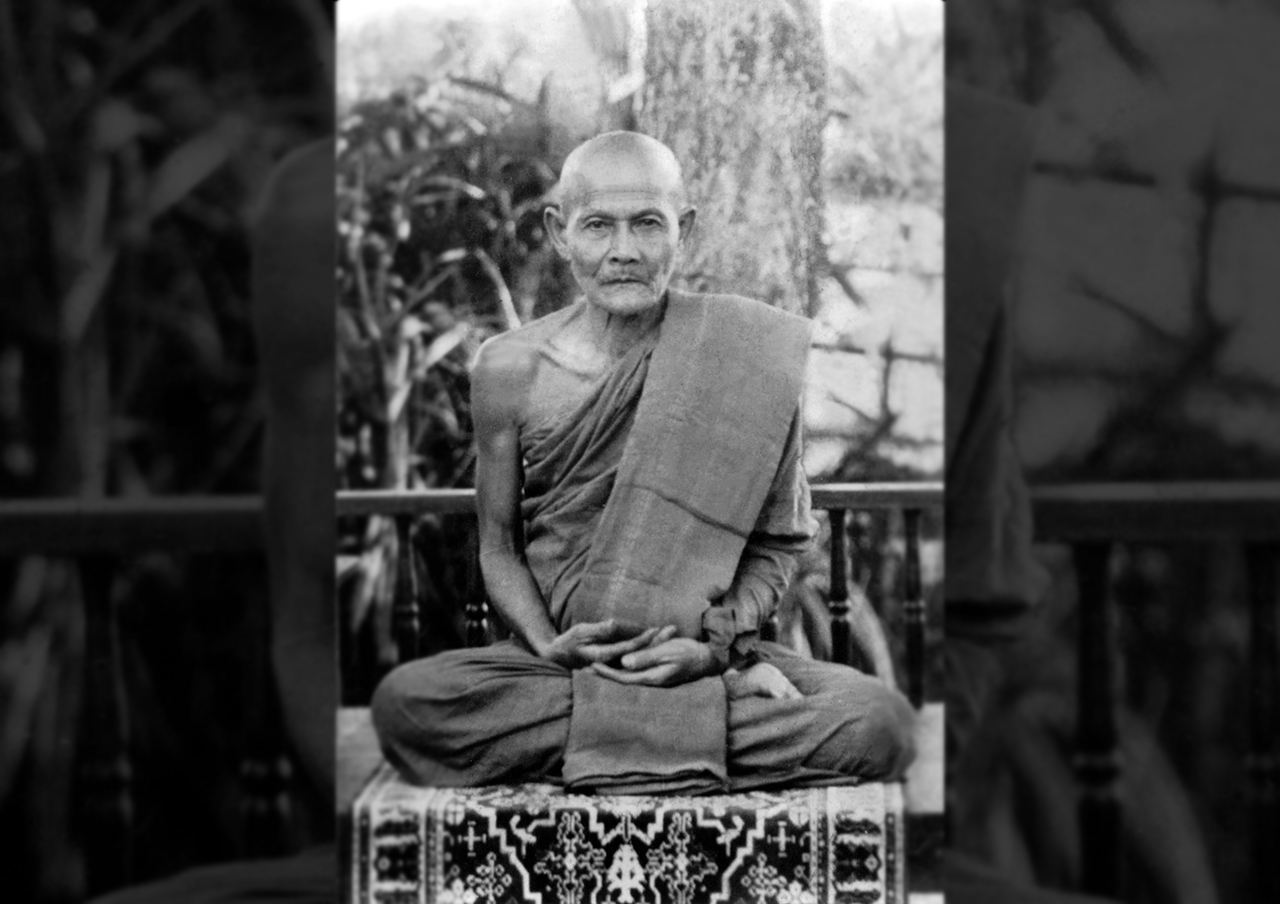
Ajarn Mun Bhuridatta Thera is a Thai Buddhist monk who along with his mentor Phra Ajarn Sao Kantasilo Mahathera established the Thai Forest Tradition (the Kammatthana tradition) that subsequently spread throughout Thailand and several countries abroad.
Ajarn Mun was born on 20 January BE 2413 which happens to be an Thursday in a farming village named Baan Kham Bong, Khong Jiam, on the western bank of the Mekong River, in Si Mueang Mai District, Ubon Ratchathani Province of North Eastern Thailand ( Issan). Khong Jiam is located in a triangle of land where the mun river flows into the Mekong River, as the Mekong turns east and flows into Laos. He was born into the Lao-speaking family of Kanhaew. His father’s name was Mr Nai Kamduang while his mother’s name was Mrs Nang Jan. He was the oldest child in the family of nine children.
When he reached the age of 16, Ajarn Mun ordained as a novice monk in the local village monastery of Kham Bong. As a novice monk, he studied Buddhist teachings, history and folk legends in Khom, Khmer and Tham scripts from fragile palm leaf texts stored in the monastery library. He remained as a novice for two years until BE 2431. Where he was required to leave the monastery by his father’s request.
By BE 2436, Ajarn Mun was ordained as a monk at Wat Liap in the provincial city of Ubon Ratchatani. Phra Ariyakavi was his preceptor. His announcing teacher was Phra Kru Prajak Ubolguna. The name “Mun “was given as the Buddhist name “Bhuridta ” (meaning “blessed with wisdom”) during his ordination.
After ordination, Ajarn Mun went to practice meditation with Ajarn Sao Wat Liap in Ubon, where he learned to practice the monastic traditions of Laos. Ajarn Sao taught him a meditation method to calm the mind, the mental repetition of the word, “Buddho. ” Ajarn Sao often took Ajarn Mun wandering and camping in the dense forests along the Mekong River, where they would practice meditation together. This is known as “Tudong” in Thai, a name derived from the term “dhutanga”, which describes a number of specialized ascetic practices. One of the first long distance Tudong was a pilgrimage to Wat Aranyawaksi in Thabor district, Nong Khai Province. At the time, Wat Aranyawaksi was a ruin, an abandoned, overgrown temple in the jungle. Ajarn Mun spent a year in “illumination”in the teak forest around the temple at this early part of his monastic life.
In BE 2442, Ajarn Mun was re-ordained in the Thammayut Nikaya, a reformed Thai sect which emphasized monastic discipline and scripture study. Having practiced under the guidance of his teacher for several years and with his teachers blessings, Ajarn Mun went out on his own to search for advanced meditation teachers. During the next several years, he wandered extensively throughout Laos, Thailand and Burma practicing meditation in secluded forests. Ajarn Mun and Ajarn Sao went on pilgrimage together in BE 2448 and venerated the Phshra Thatrine, aom center of Theravada Buddhism for centuries, most sacred to the Lao people.
Ajarn Mun’s mode of practice was solitary and strict. He followed the Vinaya (monastic discipline) faithfully, and also observed many of what are known as the 13 classic dhutanga (ascetic) practices, such as living off alms, wearing robes made of cast off rags, dwelling in the forest and eating only one meal a day. Searching out secluded places in the wilds of Thailand and Laos, he avoided the responsibilities of settled monastic life and spent long hours of the day and night in meditation. His reclusive nature, he attracted a large following of students willing to endure the hardships of forest life in order to study with him.
Ajarn Mun was born in Ubon Ratchathani, Thailand in BE 2413. Ajarn Mun had a lively mind when he was young. He excelled in folk arts such as impromptu songs and was keen on spiritual practice. After becoming a monk, he went to follow an outstanding local forest monk Ajarn Sao, learned meditation from him, and learned that strict discipline is very important for spiritual progress. He became a disciple of Ajarn Sao and actively devoted himself to practice.
There are two elements (i.e. meditation and strict discipline) which, while perhaps inconspicuous from the vantage point of the present, were, however, at a time when discipline had become very lax throughout the region and meditation was greatly viewed with suspicion At the time it was thought that anyone who might have an interest in the “dark arts” would be foolish enough to approach it, which was thought to drive people mad or enchant the mind.
Ajarn Mun duly and successfully explained and demonstrated the efficacy of meditation to many and became an example of a higher standard of conduct for the Sangha. Furthermore, despite his remote location, he became the most respected spiritual teacher in the country. Almost all twenty Ajarn Mun is one of the most accomplished and respected Zen masters in Thailand in the century, either directly under him or deeply influenced by him.
Ajahn Mun was born in Bangkampong Village in the countryside of Udon Rajathani Province in Northeast Thailand in BE 2413. He became a monk in BE 2436. Since then, he has traveled around Thailand, Myanmar, and Laos all his life, and spent most of his time in the forest. . From BE 2472 to 2483, Ajarn Mun lived in the forests and wildernesses of Chiang Mai and Myanmar for 11 years, and at this time he was certified as Arhat. He had a large number of disciples, and then spread throughout Thailand and several overseas countries, and finally passed away in Wat Suddhavasa at the age of 79 in BE 2492.
In his early years, Ajarn Mun initially started his dhutanga procession in the northeast of Nakhon Phanom, Thailand. From there, he traveled through Sakon Nakhon and Udon Thani, then via northern Chiang Mai to Buma, where he briefly Stop for a while, and finally return to Thailand.
Not long after, he entered Laos again and spent a period of dhutanga life in Luang Puang, Laos. Before returning to Le Province, Thailand, he will bypass the capital of Laos, Vientiane (Vientiane). Starting from the Northeast , he marched in sections until Bangkok, and spent the vassa at Wat Arun (Temple of Arun) in Thailand, and then spent the next vassa at the Salika Cave. After leaving the Salika Cave, he immediately Return to the Northeast.
During this extensive procession years, he was almost alone. Only in rare cases, he was accompanied by other monks, but they soon parted ways. Because Ajarn Mun has always been an independent spirit. Practice, so he stays away from noise and other monks. In his life as a monk, practicing dhutanga parade alone made him feel more comfortable, only the mind has reached a very firm level in the achievement of liberation, and compassion Aroused in his heart, it made him think that he must guide other fellow practitioners before interacting with other monks. It was this motivation and reason of compassion that made him leave the peaceful and quiet Salika Grottoes and rush to the Northeast Province Mentor anyone you’ve met on your previous marches.
Returning from this trip, Ajarn Mun decided to devote all his energy to guiding those monks and lay people who trusted him. He returned to the provinces he had visited before and soon found that he could win the confidence of monks and lay people everywhere. Many lay people were moved by Ajarn Mun’s guidance, so they decided to become monks and live a life of practice like him. Even some senior Zen masters abandoned their self-esteem and declared their willingness to belong to Ajarn Mun’s practice. Their minds later became very solid in terms of meditation, so they are very confident that they can guide other people.
You must be logged in to post a comment.